
What happens in the manosphere?
“Women are taking everything from us”

Overview
The manosphere is a collection of male-centred ideas, ranging from masculine self-improvement and gym tips to harmful beliefs and violence. Exposure to the less extreme content can be positive, however frequent engagement with these spaces tend to push boys and young men toward problematic content, which can lead to them developing harmful misogynistic ideas and attitudes.
Learn how to identify content from the manosphere and whether someone you know might be getting influenced by its ideas.
What are the main ideas of the manosphere?
While the manosphere includes many different websites, influencers, and online communities, similar ideas and narratives appear across these digital spaces. Researchers often describe the manosphere as a new form of men’s rights activism that, at its core, argues that gender equality and women’s liberation threaten men’s status in society (Equimundo, 2025). In some cases, these communities also overlap with or are used to recruit people into harmful right-wing or conspiratorial movements.
The content doesn’t always look extreme at first as it is often mixed with self-improvement advice, humour, or lifestyle content. However, beneath this surface, several recurring themes shape how followers are encouraged to think about masculinity, relationships, and women.
Rigid ideas about masculinity
Manosphere content promotes very strict ideas about masculinity and what it means to be a “real man”. Men are encouraged to prioritise dominance, status, and financial success and showing vulnerability or asking for help is framed as weakness. This puts huge pressure on young men and boys and acts to isolate people who are in the manosphere and can make it hard for them to leave.
The “Red Pill”
One of the most common ideas in manosphere spaces is the concept of “The Red Pill”. Borrowing its name from the film The Matrix, the term suggests that followers have “woken up” to hidden truths about gender and society. In this framing, mainstream culture is said to hide the reality that men are disadvantaged and must reclaim power in relationships and social life.
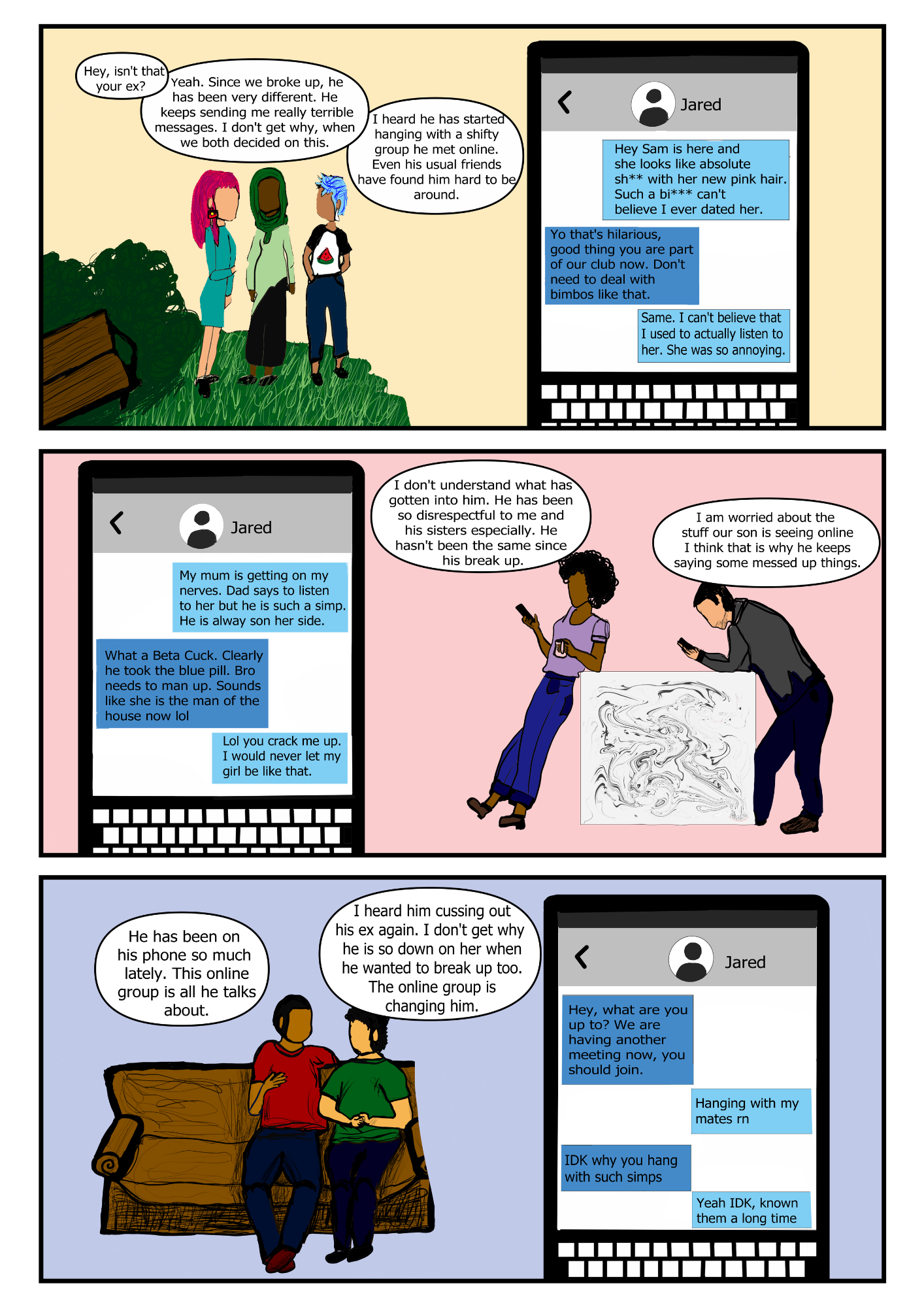
This cartoon illustrates a scenario in which a young boy develops disrespectful attitudes toward women and girls after seeking help online following a breakup. It shows the concerns his ex, friends and family have about his behaviour as he continues to engage with more extreme and divisive narratives.
Women are causing men’s suffering
A widespread belief in the manosphere is that when women gain something, men lose in return. For example, for women to be given more opportunities and rights, men are having these opportunities and rights taken away from them or that for a woman to reject a man, the woman takes the man’s power and dignity.
Blaming women creates a target and makes the men out to be unfair victims. For example if a girl is chosen to be the leader of a school club, it can be tempting to think she denied a boy the position, but this ignores the fact that other women were also denied the position, and that the girl was most likely the most suitable person for the position. Meanwhile in the dating world, getting rejected can feel frustrating but it would seem reasonable for a man to reject a woman they aren’t interested in. It’s important to recognise everyone gets a choice and rejection isn’t personal. With this mindset, it can be easy to develop feelings of anger and misery, which can devolve into wanting to hurt women (PBS NewsHour, 2025).
Ranking people and relationships and competition amongst men
In the manosphere’s perspective, everyone can be judged and ranked by things like your appearance, your job, and how much money you have. Achieving social status and superiority over women and (sometimes over other men) is presented as a key measure of success (PBS News, 2025). For example, they label rich and handsome men as ‘high-value’, while dismissing average-looking and working men as ‘low-value’. Meanwhile, women are commonly rated by appearance, such as being ranked ‘3/10’ or ‘8/10’ as a basis for pursuing and dating them.
Relationships are treated less as emotional connections and more as competitive transactions. Reducing people down to numbers or status, is deeply dehumanising, leading to disrespect and preventing genuine friendships or relationships. It can also lead to pessimism and nihilism among young men and boys, who then follow harmful and extreme advice to “improve their status” (Botto & Gottzen, 2023; Joseph Bernstein, 2026).
Overlap with other forms of hate:
While the manosphere focuses heavily on gender, the ideas shared in these spaces often connect with other forms of prejudice. Misogynistic beliefs about women’s roles and “natural” differences between men and women can easily extend to claims about differences between races, cultures, social classes, or people with disabilities.
In some online communities, discussions about masculinity and dating begin to blend with broader grievances about society. Followers may be encouraged to blame immigration, multiculturalism, economic inequality, or social progress for their frustrations. These narratives can create an “us vs them” worldview, where certain groups are seen as threats to men’s status or opportunities. Over time, this can create a web of connected online spaces where different forms of hate reinforce each other.
Understanding these overlaps helps explain why addressing misogyny online is important not only for gender equality, but also for preventing the spread of other forms of hate and division.
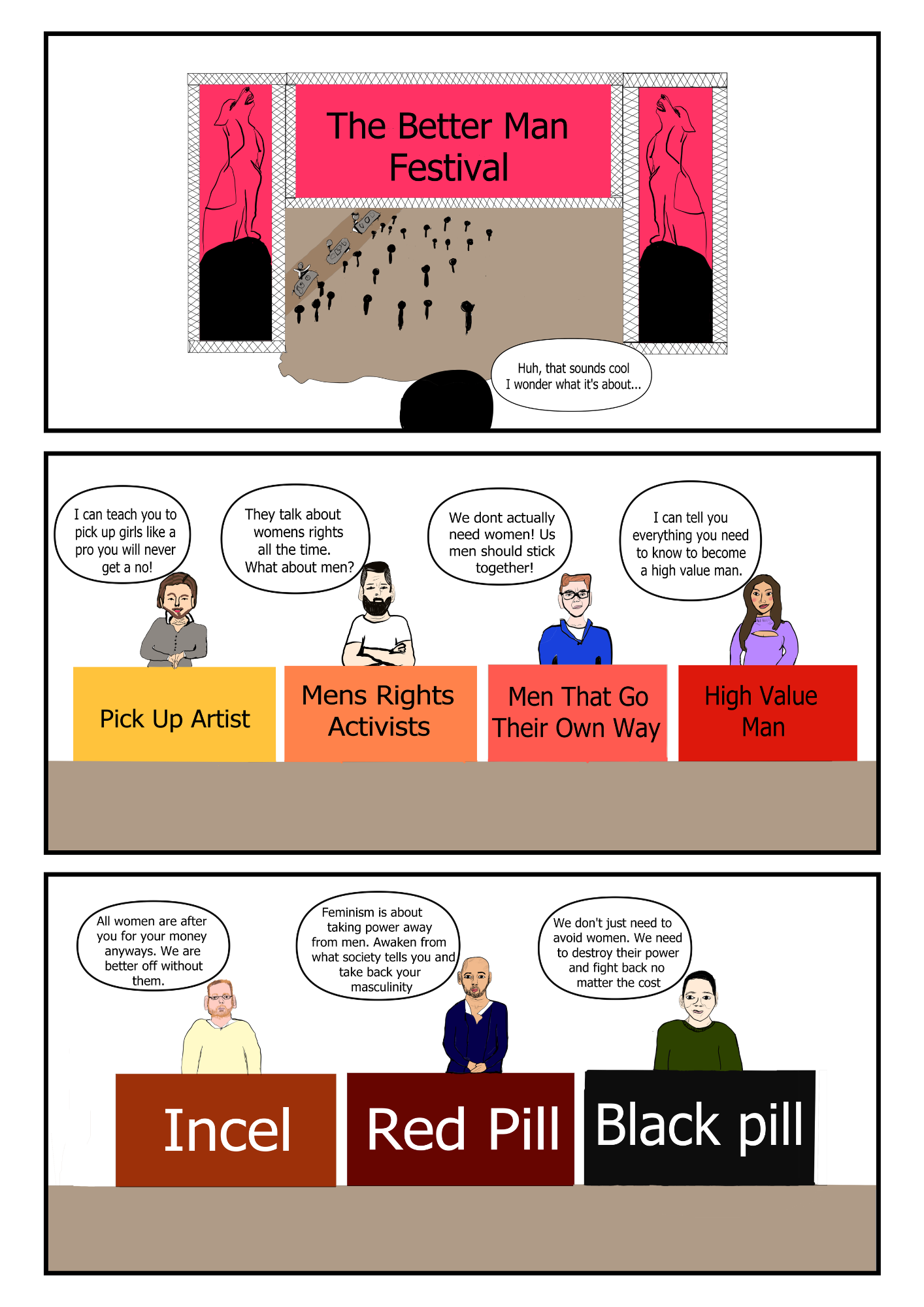
This cartoon highlights some of the different groups within the manosphere, that may draw people in through the appeal of helping young boys be “better men”. It illsutrates the various spaces and sub-idelogies present within the manosphere often catering to different ideas and prespectives but all sharing the same toxic undelrying currents disguised as self-help for young men.
Why is it appealing and how do these ideas spread?
Boys and young men have traditionally been told they need to be successful, have power over women and be self-reliant (Mahalik et al., 2003). However, as recent feminist movements (such as the #MeToo campaign) have propelled women and women’s rights to the forefront, teenage boys and young men have reported feeling displaced, uncertain in their gender role (Whippman, 2024), and self-conscious of their words and actions towards girls and women (Townsend, 2025). Additionally, young men may also have less emotional literacy and support, and thus struggle with loneliness and relationships by themselves.
It is important to know how these ideas and narratives spread so that we can understand how they are so persuasive to young people. The success of many manosphere influencers is largely because of how those ideas are delivered. Through a mix of humour, lifestyle advice, and online community building, harmful messages are often introduced gradually and packaged in ways that feel relatable or motivating.
These strategies make the content easier to engage with and harder to question. The following section explores some of the common tactics used to attract viewers and keep them engaged in these online spaces.
Mixing Self-Improvement With Ideology
Many creators begin with content that feels positive or practical, such as fitness advice, confidence tips, financial motivation, or dating guidance. These topics genuinely appeal to young men looking to improve their lives. Unfortunately this advice is often paired with messages that blame society for men’s struggles and because the helpful content comes first, the harmful ideas can feel like natural extensions of the same advice rather than something separate or extreme.
Algorithm Amplification
Social media platforms are designed to keep people watching. Once someone interacts with a certain type of content algorithms may begin recommending more of it.
Research has found that social media platforms can begin recommending misogynistic or extremist-adjacent content to new users within a short period of time, especially when users engage with videos about masculinity or relationships (Baker et al., 2024). Over time, feeds can become dominated by similar content, reinforcing the same perspectives.
Parasocial Relationships With Influencers
Many manosphere creators build strong personal brands and present themselves as mentors or role models. Followers may feel as though they have a personal connection with these influencers. These parasocial relationships can make viewers more likely to trust the influencer’s advice and defend them from criticism.
Preparing Followers for Criticism
Many influencers anticipate criticism of their content and address it directly in their videos. Viewers are told that the media, schools, or “mainstream society” will try to silence them or label their ideas as harmful. This can make criticism appear predictable and even validating.
By positioning disagreement as proof that they are exposing uncomfortable truths, influencers can make followers more likely to distrust outside perspectives. When family members, teachers, or friends challenge these ideas, it can reinforce the narrative that others simply “don’t understand.” Over time, this can make it harder for young people to critically engage with alternative viewpoints and easier for online communities to become the main source of guidance and information.
Building Community while increasing isolation
Finally, manosphere spaces often offer something many young people are looking for: a sense of belonging. Online forums, comment sections, and fan communities can create the feeling of being part of a group that understands shared frustrations. For young men experiencing loneliness or uncertainty, these spaces may feel like one of the few places where they are listened to or understood (Ging & Siapera, 2025). When these communities are built around narratives that portray women or society as adversaries, the sense of belonging can come with increasing distance from other perspectives.
As online engagement grows, followers spend less time interacting with people who challenge these ideas in their offline lives. Tightly connected digital communities reinforce shared beliefs and gradually narrow the range of perspectives individuals encounter (Botto & Gottzen, 2023). This can deepen feelings of isolation while strengthening loyalty to the community itself.
What does gendered hate and violence look like?
Gendered hate and violence simply means insults and attacks targeted towards women based on their gender. From the thoughts and feelings developed under the manosphere, teenage boys and men can, and have, inappropriately targeted women in the following ways:
- Harassment at school and university towards peers and teachers: This includes calling female peers and teachers names, dismissing their words or feelings, and making sexual comments (e.g. telling a teacher their ‘boobs look big’ or ranking female classmates in order of ‘attractiveness’) .
- Online harassment and exclusion: For example telling girls or women that they suck at gaming and that it’s for men only, targeting them in-game for kills, and other misogynistic comments or behaviours on games and social media.
- Manipulative dating and relationships: This includes catfishing on dating apps to trick women into entering a relationship with them, controlling their use of money, who they vote for, who they can meet up with or talk to, and what jobs they can do.
- Physical and sexual violence: This includes sexual harassment, rape, and femicide. Many men under the manosphere may not go this far, but spending more time in the manosphere can increase their likelihood of entertaining and justifying these behaviours.
Other risks of the manosphere
Men influenced by the manosphere can develop broader social grievances, coming to believe that society as a whole has wronged them. Some men and boys adopt a worldview, known as “the black pill”, where sexual and romantic relationships, career opportunities, and overall wellbeing are seen as fixed outcomes based largely on physical attractiveness or status (Exclusion and Extremism, 2024) This can lead to a sense of hopelessness and nihilism making self-improvement feel pointless. For some, this manifests as depression and suicidality; for others, it is redirected outward as anger and resentment toward society. In more extreme cases, these beliefs can contribute to the justification of violence, which is why there is growing concern about the potential for manosphere-influenced radicalisation and acts of terrorism.
Attacks on the general public have happened before. One such incident is the 2014 Isla Vista rampage, where Elliot Rodgers killed three innocent men, three young women and wounded another 13 people who happened to be in the area. His motive was to destroy the lives of attractive and popular people who hadn’t accepted him. Another incident is the 2018 Toronto van attacks, where Alek Minassian drove a van into pedestrians on a busy street, killing nine women and two men, while seriously wounding another fifteen. His motive was also to get revenge against women.
There are clear overlaps between the ideas promoted in parts of the manosphere and those found in far-right movements, particularly in how they frame power, identity, and grievance. Both male supremacist and white supremacist ideologies rely on the belief that a particular group is being unfairly pushed down by social change, and that this loss of status needs to be corrected. In manosphere spaces, this often starts with messages about relationships or masculinity, but can gradually shift into broader narratives about society being “broken” by feminism, diversity, or equality. Because these ideas share a similar “us versus them” worldview, the transition into more explicitly far-right content can feel like a natural step rather than a sudden leap. For some young men, the manosphere becomes an entry point, acting as a space where frustration is first validated, then redirected toward wider groups, making it easier to introduce more extreme beliefs over time (Institute for Strategic Dialogue, 2023).
While the harms of the manosphere are real, it’s important to remember that many men and young people do question, disengage from, and ultimately leave these spaces. Change is possible, especially when people are met with empathy, critical thinking tools, and healthier models of identity and connection. If you’re interested in understanding how and why people step away from the manosphere, and how you can support this process, read our companion article, which explores leaving these spaces in more depth.
The video below, developed by White Ribbon as part of the My Friend Max Hate campaign, shows how toxic personalities and manosphere influences prey on young men’s insecurities — fuelling hatred and violence when they’re most vulnerable. Some of the content in the video is quite triggering (misogyny, homophobia, bullying, gender based violence) and viewer discretion is advised.
References
Almog, O., & Kaplan, D. (2017). The manosphere and the male dating industry: A case study of pick-up artists. Men and Masculinities, 20(5), 1–20.
Baker, C., Andreasen, M. B., & Ging, D. (2024, April). Recommending toxicity: The role of algorithmic recommender functions on YouTube Shorts and TikTok in promoting male supremacist influencers. DCU Anti-Bullying Centre, Dublin City University. https://www.dcu.ie/antibullyingcentre/recommending-toxicity
Botto, M., & Gottzén, L. (2023). Swallowing and spitting out the red pill: young men, vulnerability, and radicalization pathways in the manosphere. Journal of Gender Studies, 33(5), 596–608. https://doi.org/10.1080/09589236.2023.2260318
Ging, D. (2019). Alphas, betas, and incels: Theorizing the masculinities of the manosphere. Men and Masculinities, 22(4), 638–657. https://doi.org/10.1177/1097184X17706401
Ging, D., & Siapera, E. (Eds.). (2025). Fostering Healthy Masculinities: Building Resilience Against Online Misogyny. https://www.isdglobal.org/wp-content/uploads/2026/01/DPL-Fostering-Healthy-Masculinities-Building-Resilience-Against-Online-Misogyny.pdf
Lewis, C., Green, H., Etherington-Benson, R., Guinness, D., & Gupta, T. (2025, November). State of UK men 2025. Equimundo & Beyond Equality. https://www.equimundo.org/wp-content/uploads/2025/11/FINAL-StateofUKMen2025-Report.pdf
PBS NewsHour. (2025, July 29). Why “manosphere” content is appealing to some young men. https://www.pbs.org/newshour/show/why-manosphere-content-is-appealing-to-some-young-men
Other resources

What is the manosphere?
Learn how these online spaces work, the types of content they promote, why young people are drawn to it, why they can be harmful and how can we support them.

How do people leave the manosphere?
Discover what makes people start questioning the hate they are seeing, understand what helps people step away and how to support someone through that process.

Free resources
Help us bring these conversations into the real world. Download our resources to display in your school or community centre. Print them out to help spread the word and share the message.
If you’re affected by this content, support is available.
Beyond blue mental health support line: 1300 22 4636
Life line: 13 11 14
eheadspace.org.au: 1800 650 890
NSW mental health line – Referral service 24/7: 1800 011 511
QLife: 1800 184 527

Sign Up to All Together Now’s Newsletter
Stay informed about our latest anti-racism programs addressing critical issues such as racism, divisive misinformation, online hate and extremism.
Our regular newsletter will guide you in unlearning racism and adopting an anti-racist mindset. You’ll receive actionable tips on how to actively challenge racism and contribute to positive social change.