
What is the manosphere?
The rise of online misogyny
With young people all over the world spending more time online, the internet and its many online communities play an important role in our emotional and social lives.
It takes just under half an hour for social media platforms like TikTok and YouTube Shorts to start recommending misogynistic content to new users (Dublin City University, 2024).
This content often appears as jokes, advice, or “hot takes” about relationships, masculinity, and gender, making it easy to overlook or dismiss. Repeated exposure can normalise disrespectful attitudes towards women and reinforce unhelpful ideas about how people should think or behave, and can increase the likelihood of encountering other forms of harmful content, such as racism.
Since this misogynistic content is woven into everyday scrolling, it can influence young people without them even realising. Harmful to girls and women, research shows it can also negatively affect the mental health and well-being of boys consuming it (Desmarais, 2024), making these patterns harder to shift once they take hold.
The ‘Manosphere’ is an umbrella term for a mix of online spaces that talk about men, masculinity and gender relations (esaftey Commisioner, 2026). Popular social media influencers frame themselves as helping build communities and speaking the truth. In reality, they are making millions of dollars from spreading hate and exploiting young men, who are at a vulnerable point in their lives as they look to build connections and cultivate their sense of identity.
Why young people are drawn in
Young people are growing up under real pressure. There is growing division in society, and for the first time in generations, many young people are coming of age in a world where their future feels less certain than that of their parents. Boys are taught that being successful means being attractive, confident, emotionally tough, and financially secure, often all at once. At the same time, there are fewer spaces where they feel comfortable talking openly about loneliness, rejection, friendships, or mental health. Online influencers telling them that it is not their fault can feel really comforting, and unfortunately, when the blame is shifted to girls it can feel like a pretty compelling argument (PBS NewsHour, 2025).
Having grown up with internet access, young boys often turn online for advice. They don’t usually search for hate. They might start with gym content, motivational clips, advice about dating, or videos about “levelling up” and self-discipline. A few likes or watches is all it takes for the tone to gradually shift.
Social media algorithms are designed to pick up on insecurities and quickly start recommending harmful content (Reset Australia, & Institute for Strategic Dialogue, 2022). Advice for gaining confidence becomes criticism of women. Relationship tips turn into messages about control or blame. What felt like practical support starts framing the world as unfair to men, offering simple explanations for complicated feelings.
Because this change happens slowly, mixed in with humour, success stories, and aspirational lifestyles, it can be hard to spot. What began as a search for belonging or direction can become involvement in online spaces that reinforce anger, resentment, and rigid ideas about what it means to be a man.
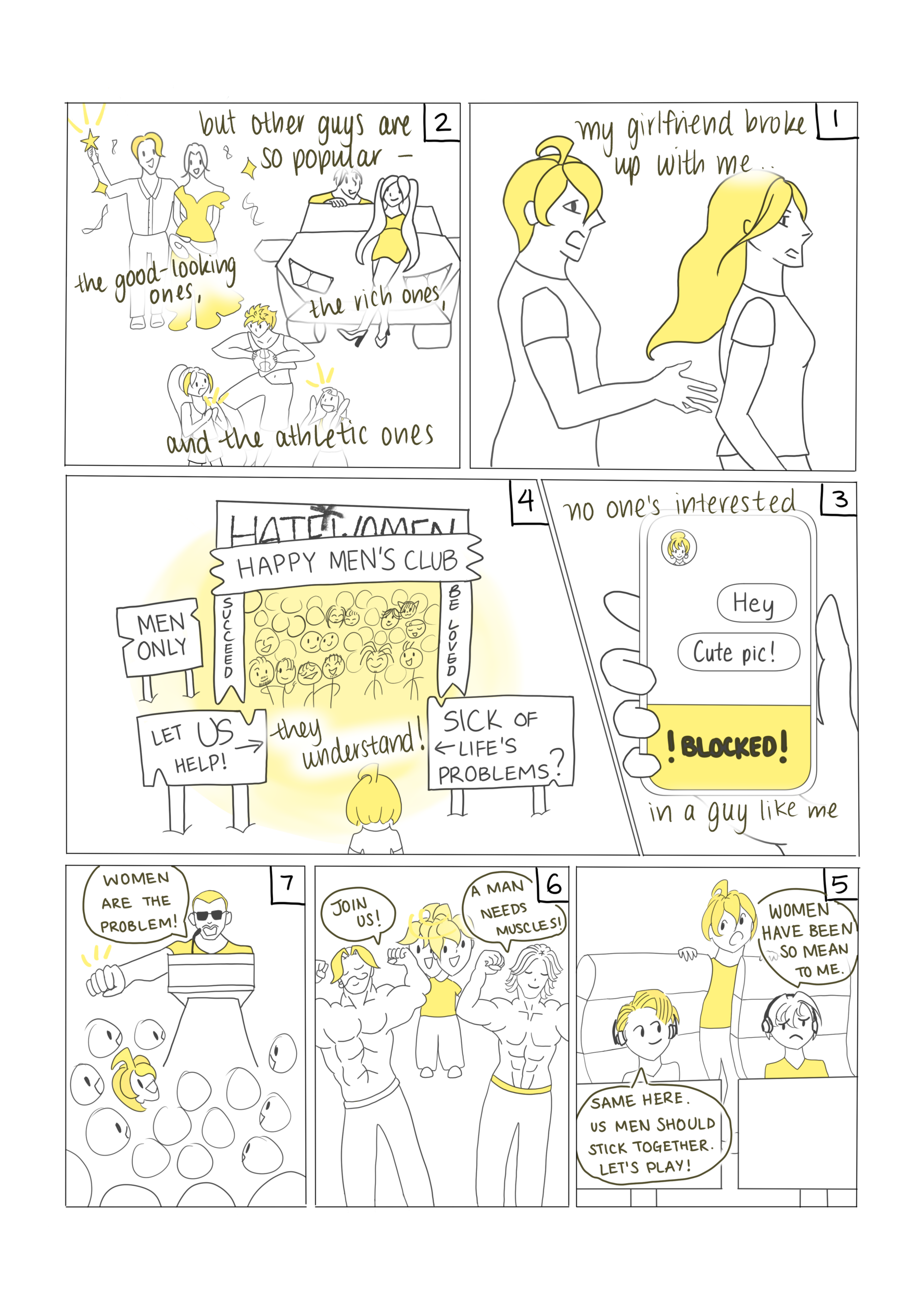
This cartoon features a young man getting involved in the manosphere after a breakup, rejection and seeing the “success” of male influencers online. It highlights that he was originally drawn into these spaces looking for self-improvement but the content he was exposed too slowly warped over time and devolved into increasingly hateful and extremist narratives.
Why this is harmful
The manosphere is harmful because it shapes how people see themselves and others in real life.
Many manosphere influencers teach that women are inferior, manipulative, or exist to serve men, ideas that can justify harassment, discrimination, and controlling behaviour and contribute to real-world sexism and gender-based violence (PBS NewsHour, 2025).
This harms girls and women by making everyday spaces less safe and by reinforcing unequal and unhealthy relationship dynamics. But it also harms boys and men.
Instead of offering genuine support, this content often promotes narrow ideas of masculinity that pressure boys to hide emotions, distrust others, and measure their worth through dominance, wealth, or sexual success.
While influencers present these ideas as self-empowerment, research shows they can distort how young men view women and themselves (Cursino & Dean, 2026). It often prevents boys from finding healthier, more positive ways to connect and grow and increases feelings of loneliness.

What parents and friends can do
If someone you know seems influenced by the manosphere or starts expressing similar opinions, it is easy as a parent or friend to panic and shut the conversation down.
However, it is important to understand the underlying cause and make an attempt to listen to their perspective.
Influencers who promote harmful views often prepare their viewers for rejection from society and their loved ones by framing criticism as proof they are correct, thus, the key to combating the spread of these ideas is to engage with young men.
Instead of telling your child or friend that these ideas are wrong, ask them to talk about their beliefs and ask critical thinking questions in a calm and positive way.
For more advice, have a look at our other articles and other resources below.
References
Desmarais, A. (2024, April 23). TikTok and YouTube show toxic content in just 23 minutes to teen boys. Euronews. https://www.euronews.com/next/2024/04/23/tiktok-and-youtube-shorts-push-misogynistic-videos-to-young-male-watchers-study-finds
Cursino, M., & Dean, G. (2026, March 6). Social media plays “huge role” in promoting traditional gender views, say experts. BBC News. https://www.bbc.com/news/articles/c4g55v1g95qo
PBS NewsHour. (2025, July 29). Why “manosphere” content is appealing to some young men. https://www.pbs.org/newshour/show/why-manosphere-content-is-appealing-to-some-young-men
Reset Australia, & Institute for Strategic Dialogue. (2022). Algorithms as a weapon against women: How YouTube lures boys and young men into the “manosphere”. https://au.reset.tech/uploads/algorithms-as-a-weapon-against-women-reset-australia.pdf
Other resources

What happens in the manosphere?
Unpack some of the key messaging, explore why this content can be appealing, how do these ideas spread, and the tactics used to keep people engaged.

How do people leave the manosphere?
Discover what makes people start questioning the hate they are seeing, understand what helps people step away and how to support someone through that process.

Free resources
Help us bring these conversations into the real world. Download our resources to display in your school or community centre. Print them out to help spread the word and share the message.
If you’re affected by this content, support is available.
Beyond blue mental health support line: 1300 22 4636
Life line: 13 11 14
eheadspace.org.au: 1800 650 890
NSW mental health line – Referral service 24/7: 1800 011 511
QLife: 1800 184 527

Sign Up to All Together Now’s Newsletter
Stay informed about our latest anti-racism programs addressing critical issues such as racism, divisive misinformation, online hate and extremism.
Our regular newsletter will guide you in unlearning racism and adopting an anti-racist mindset. You’ll receive actionable tips on how to actively challenge racism and contribute to positive social change.