
How do people leave the manosphere?
Leaving the manosphere can be a slow and difficult process. Over time, these spaces encourage boys and young men to adopt a particular way of thinking and seeing the world, making it hard to step away, even when the cracks start to show and the content they once found empowering no longer feels helpful.
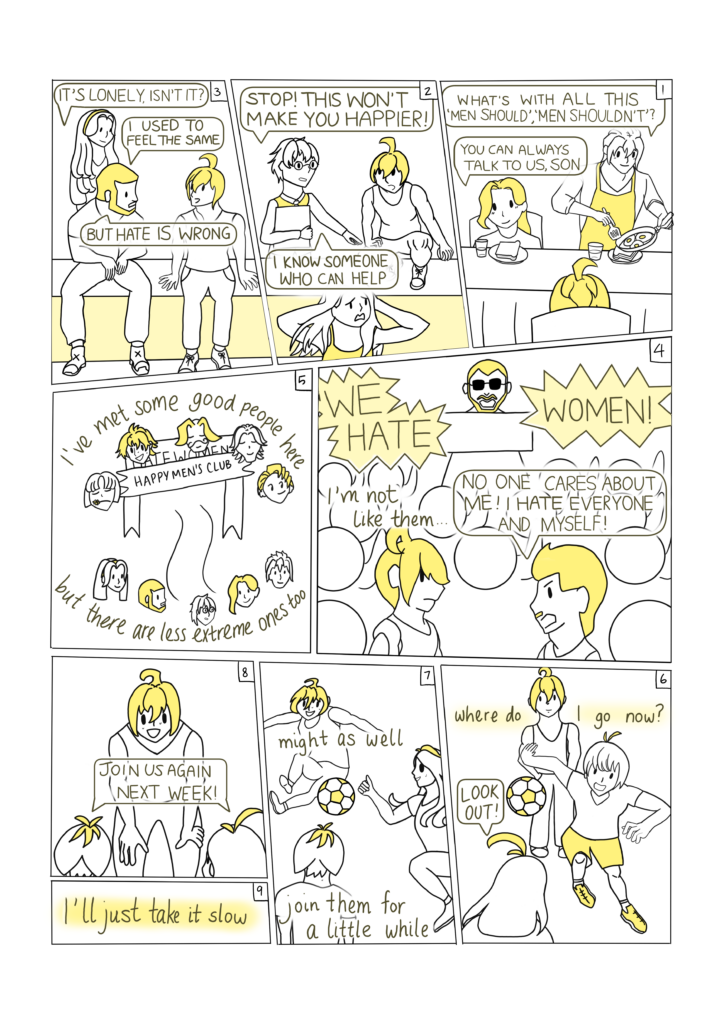
This comic shows the parents of a young man talking to him about what he’s seeing online. What ends up getting through to him is being shown empathy. The next time he is in manosphere spaces, he starts questioning the things he is seeing and hearing. He then starts re-engaging with IRL friends through a social football club. This comic was created by C.Z.
They start to realise the content that was marketed as self-improvement, and initially made them feel hopeful and “in control”, actually leaves them feeling vulnerable, isolated, and frustrated. The communities that they joined seeking connection with groups of “men who understand the struggle” instead revolve around competition and criticism. At the same time, relationships in the offline world have become strained. Friends may have distanced themselves, and conversations with family members may have escalated into arguments or been shut down entirely.
By this point, reaching out for support can feel difficult or even impossible. When the topic was first raised, loved ones may have tried to challenge these ideas directly, only to be dismissed or pushed away. Over time, those conversations may have stopped altogether. For someone caught in this cycle, leaving can feel like it means losing the only community that understands them.
But change is possible and many people do find their way out. This blog focuses on what makes people leave the manosphere and how to support loved ones in this journey.
What makes people start questioning the hate they are seeing?
It is often not one sudden revelation that make people leave the manosphere. More commonly the accumulation of small moments of doubt, when experiences in the “real world” that do not quite match the narrative spread, that make people overtime question the hate they are seeing and eventially withdraw from harmful online spaces. Even after initially distancing themselves from the content, some of the more pervasive ideas can still linger.
Some participants begin questioning the ideology when it stops improving their lives as promised. Instead of feeling more confident or successful, many described becoming more isolated and angry, as feeling increasingly pessimistic about relationships and the future (Botto & Gottzen, 2024; Doherty et al., 2026). For others, real-life relationships challenge the narratives they encounter online. Positive friendships, supportive partners and family members, or mentors can expose contradictions between the online ideology and the complexity of real people and experiences. Bryan Campbell, who says he was “red-pilled” aged 12, was able to leave the manosphere after being confronted by his older brother. For him, one of the things his brother pointed out that stuck with him and he struggled to reconcile, was that many of the influencers he admired, were white supremacists and did not support his existence as a young black boy (see Campbell, 2025).
Forming stronger real-world connections is a common reason people begin to step back from these communities. Engaging in friendships, hobbies, education, or work that provides positive social feedback can create alternative sources of belonging that reduce reliance on online spaces (Doherty et al., 2026).
Questioning the ideas spread in the manosphere does not mean someone immediately leaves these spaces, but it often leads to a period of uncertainty, where they continue engaging with the content while also beginning to reflect critically on it. In Bryan’s case, he describes thinking about that conversation with his brother for weeks. For others, the process can take much longer. Disengagement is often gradual and tied to broader life changes, such as new friendships, improved mental health, or greater confidence outside of online communities.
Moments of doubt can mark the first step toward stepping away from communities built around resentment and division, and toward rebuilding healthier perspectives and relationships. They can also open the door for supportive conversations with friends or family that may help reduce the sense of isolation that often keeps people connected to harmful online spaces.
This short video from The Guardian features a former “red piller” talk about how he left and the struggles he faced.
What helps people step away, and how can friends and family help?
Strong offline communities provide an important alternative to online spaces. Participating in group activities, such as sports and volunteering, gives young men opportunities to experience connection and recognition in the real world. Positive male role models such as coaches, teachers, or mentors show that confidence, strength, and social respect do not rely on rigid hierarchies or harmful ideas about women.
Understanding how algorithms push certain content can help young men regain control over what they consume online. It can also be helpful to help them understand how the content they are consuming, is designed to make the poster money, either by increasing their engagement or by directly selling products and services such as courses. In Louix Theroux’s documentary “inside the manosphere” he points out the contradiction between HSTikkyTokky using his platform to promote OnlyFans models, while simultaneously saying that watching porn is a bad thing, which is a really clear example of this. When people understand that content is designed to keep them engaged and make money for others, it becomes easier to step back and think critically.
Alternative models of masculinity give young men different ways of seeing themselves. Seeing examples of strength combined with emotional intelligence and respectful relationships helps them imagine healthier ways of connecting with others. Real-life role models, stories, and media can all reinforce these ideas, supporting the development of a more balanced and confident identity.
Non-judgmental conversations play a powerful role. Listening carefully, asking thoughtful questions, and showing genuine curiosity helps someone feel heard and respected. Publicly shaming or dismissing their beliefs pushes them further into isolation. Gentle, calm conversations create space for reflection and allow young men to start questioning ideas they once accepted without feeling attacked. Friends and family can be well placed to have these conversations, but they can be challenging when confronted with the harmful and hateful content promoted by the manosphere. For practical tips and strategies, download our full conversation guide.
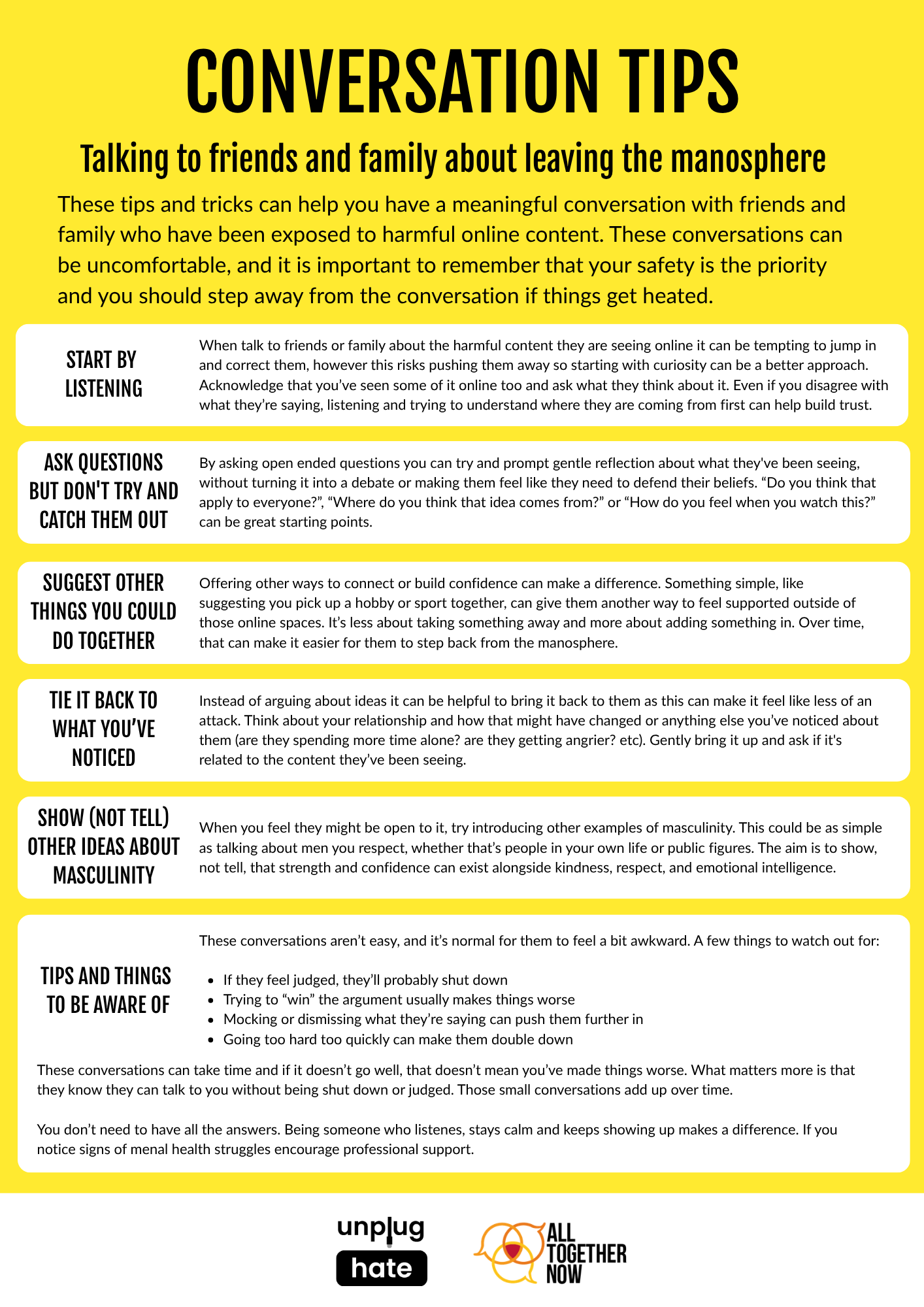
Leaving the manosphere is possible. It can take time, and support makes all the difference, but many young men do step away from these spaces and start building healthier ways of seeing themselves and connecting with others.
As a friend or family member, you play an important role. Listening, showing curiosity, and offering support can help someone start to question ideas and explore different perspectives. Small, steady conversations and opportunities to connect with the real world can rebuild trust, confidence, and a healthier sense of self.
References
Botto, M., & Gottzén, L. (2023). Swallowing and spitting out the red pill: young men, vulnerability, and radicalization pathways in the manosphere. Journal of Gender Studies, 33(5), 596–608. https://doi.org/10.1080/09589236.2023.2260318
Campbell, B. (2025). At home during COVID school closures, I found myself drawn to the manosphere. [online] Chalkbeat. https://www.chalkbeat.org/detroit/2025/02/12/alone-during-covid-i-was-drawn-to-manosphere
Doherty, L., Dowling, C., & Dickens, M. (2026). Disengagement from online misogynistic incel communities and its implications for attitudes to gendered violence (Trends & Issues in Crime and Criminal Justice No. 727). Australian Institute of Criminology. https://www.aic.gov.au/sites/default/files/2026-03/ti727_disengagement_from_online_misogynistic_incel_communities.pdf
Other resources

What is the manosphere?
Learn how these online spaces work, the types of content they promote, why young people are drawn to it and why they can be harmful and how we can support them.

What happens in the manosphere?
Unpack some of the key messaging, explore why this content can be appealing, how do these ideas spread, and the tactics used to keep people engaged.

Free resources
Help us bring these conversations into the real world. Download our resources to display in your school or community centre. Print them out to help spread the word and share the message.
If you’re affected by this content, support is available.
Beyond blue mental health support line: 1300 22 4636
Life line: 13 11 14
eheadspace.org.au: 1800 650 890
NSW mental health line – Referral service 24/7: 1800 011 511
QLife: 1800 184 527

Sign Up to All Together Now’s Newsletter
Stay informed about our latest anti-racism programs addressing critical issues such as racism, divisive misinformation, online hate and extremism.
Our regular newsletter will guide you in unlearning racism and adopting an anti-racist mindset. You’ll receive actionable tips on how to actively challenge racism and contribute to positive social change.